 Istanbul Turkey Package Tours
The Best Time to Visit Turkey
The best time to visit Turkey depends on where you are going and what you want to do. Istanbul works almost year round. Cappadocia rewards early risers whenever the balloons fly. The Aegean ruins at Ephesus and the Pamukkale travertines punish anyone who walks them at midday in summer. This guide sets out the month by month figures for Istanbul, Cappadocia and the Aegean, then explains what each season means for a tour package that starts in Istanbul, from Turkey tour packages that cover all three regions to short Cappadocia fly-ins.
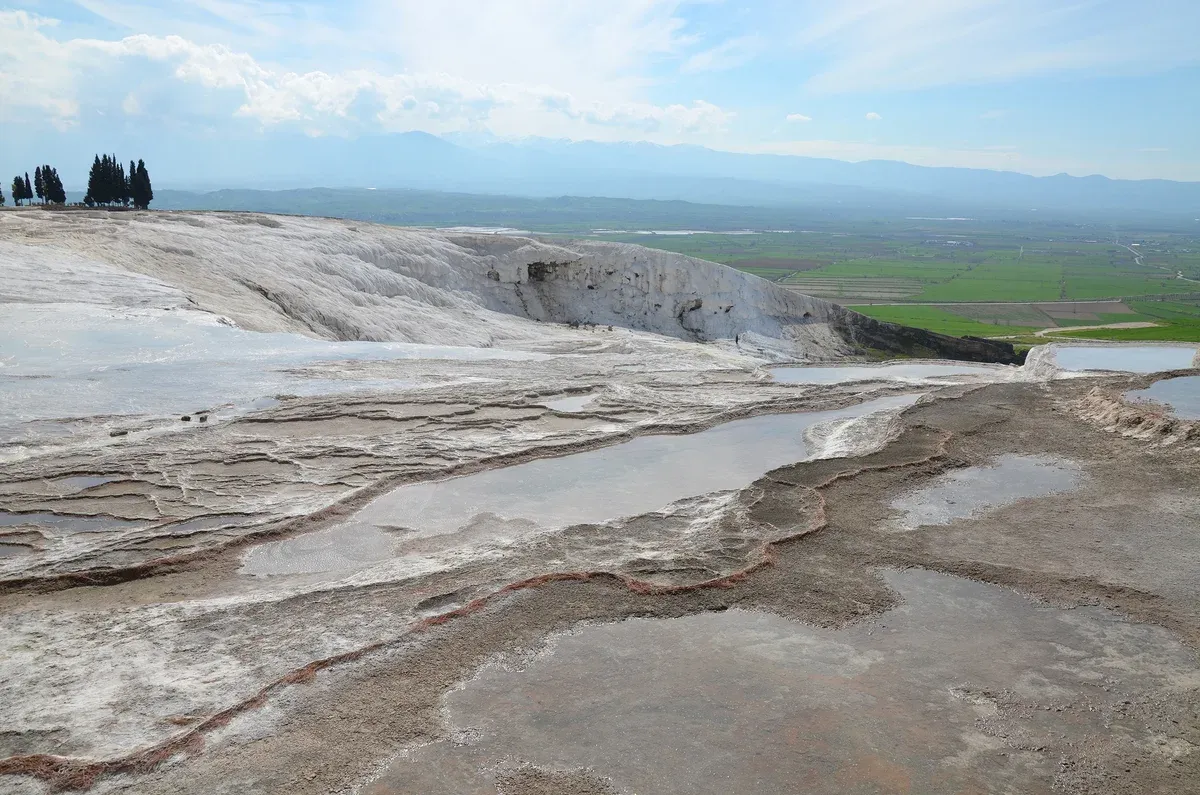
The Pamukkale travertines. Photo: Carole Raddato from FRANKFURT, Germany, CC BY-SA 2.0, via Wikimedia Commons
Quick answer When to go
April to May and September to October are the best time to visit Turkey, with Istanbul at 16.1 to 21.0 C in April and May and 19.9 to 24.6 C in September and October. Spring ranks first and autumn second in one long-running Turkish travel planner. These windows avoid the 35.7 C July mean high at Denizli and the January snow on the Cappadocia plateau, where the mean low is -3.5 C. June to August is the peak season with the biggest crowds, and November to March is the low season with the lowest prices.
Key takeaways
- For one trip that covers everything, the 7-Day Best of Turkey Tour fits the spring and autumn windows best, at $1,713 per person with 3 domestic flights.
- Short on time? The 2-day all-inclusive Cappadocia trip with a cave hotel night fits April to November, the peak balloon season.
- Compare every season side by side in the comparison table and the guide to what a package includes on the homepage.
- Ramadan and the Bayram holidays change travel conditions each year. The month by month table below and the best time to go section show how.
Turkey Month by Month
Turkey has no single best month because the plateau, the Aegean coast and the Mediterranean sit in different climates. The table below compares the three regions your tour package covers, using mean daily highs and lows and rainfall from 1991 to 2020 normals published by the Turkish State Meteorological Service. Istanbul figures come from the Kirecburnu station, Cappadocia from Nevsehir at 1,224 m, and the Aegean from Izmir, the nearest big station to Selcuk and Ephesus.
Temperatures and Rainfall Across the Year
Istanbul runs mild and wet in winter, warm and dryish in summer. Cappadocia sits on a plateau over 1,000 m high, so its winters bring frost and snow and its summers stay dry, with under 10 mm of rain in both July and August. Izmir on the Aegean is the warmest of the three in summer at 33.8 C in July but also the wettest in winter at 131.3 mm in December.
Read each column against your own plan: ruins and hiking in the Aegean, balloons in Cappadocia, city sightseeing in Istanbul.
| Month | Istanbul | Cappadocia | Aegean | Notes |
|---|---|---|---|---|
| January | 8.8 / 3.6 C, 96.1 mm | 4.1 / -3.5 C, 43.7 mm | 12.7 / 6.0 C, 127.5 mm | Among the lowest prices of the year, snow possible in Cappadocia |
| February | 9.4 / 3.5 C, 87.7 mm | 6.0 / -2.6 C, 41.8 mm | 14.0 / 6.6 C, 107.2 mm | Low prices, winds stronger in Cappadocia |
| March | 12.0 / 4.9 C, 69.8 mm | 10.9 / 1.0 C, 47.5 mm | 17.2 / 8.6 C, 77.8 mm | Low crowds, Ramadan may fall here in some years |
| April | 16.1 / 8.1 C, 45.1 mm | 16.3 / 5.2 C, 45.7 mm | 21.3 / 11.8 C, 50.1 mm | Tulip festival in Istanbul, balloon season in swing, 23 April holiday |
| May | 21.0 / 12.8 C, 37.1 mm | 21.2 / 9.3 C, 57.4 mm | 26.5 / 16.2 C, 32.9 mm | Crowds rise, 19 May holiday, sea at Antalya 21.1 C |
| June | 25.7 / 17.4 C, 44.7 mm | 25.6 / 12.3 C, 37.5 mm | 31.3 / 20.9 C, 14.4 mm | Peak season starts, school holidays from mid-June |
| July | 28.0 / 20.3 C, 36.3 mm | 29.3 / 14.6 C, 9.9 mm | 33.8 / 23.5 C, 3.0 mm | Hottest and driest, Denizli hits 35.7 C, Jazz Festival in Istanbul |
| August | 28.2 / 21.2 C, 43.5 mm | 29.4 / 14.5 C, 9.6 mm | 33.6 / 23.7 C, 6.7 mm | Peak heat at Ephesus, sea at Bodrum 27.4 C |
| September | 24.6 / 17.4 C, 81.3 mm | 25.3 / 11.3 C, 13.7 mm | 29.5 / 19.5 C, 23.5 mm | High crowds, sea still 27.4 C at Antalya and 26.8 C at Bodrum |
| October | 19.9 / 13.6 C, 98.3 mm | 19.1 / 7.4 C, 29.4 mm | 24.6 / 15.4 C, 56.5 mm | October prices run 10 to 15 percent below September, vineyard colours in Cappadocia |
| November | 15.0 / 9.2 C, 100.5 mm | 11.6 / 2.1 C, 33.4 mm | 18.8 / 10.9 C, 99.6 mm | Low season, many beach hotels close |
| December | 10.7 / 5.5 C, 124.8 mm | 6.2 / -1.4 C, 48.4 mm | 14.0 / 7.7 C, 131.3 mm | Wettest month in Istanbul and Izmir, snowy Cappadocia, lowest prices with January and February |
So Which Months Are Best
April to May and September to October are the best months to visit Turkey. Istanbul sits at 16.1 to 21.0 C in spring, Ephesus and Pamukkale stay walkable before the summer furnace, and the Cappadocia balloon season runs at full strength. One guide rates crowds as medium in April and high in May, then high in September and medium in October, so late April and October give you the weather with slightly thinner crowds and, in October, prices 10 to 15 percent below September.
- Best overall: April, May, September and October
- Cheapest: January, February and December
- Best for the sea: July and August, when Antalya's sea peaks at 27.8 to 28.8 C
- Best for balloons: April to November, the season guides call the peak
Sources: Wikipedia: Turkey, Wikivoyage: Turkey
Istanbul, Cappadocia and the Aegean
A package tour from Istanbul crosses three different climates in one week. Each region has its own best window, and the differences matter more than the national picture.
Istanbul
Istanbul averages an 18.3 C high, an 11.5 C low and 865 mm of rain a year, with about 15 snow days mostly from December to February. Its wettest month is December at 124.8 mm and its driest is July at 36.3 mm. April and May bring the Tulip Festival, which runs through April, with well over ten million bulbs planted in city parks and Emirgan Park free daily from sunrise to sunset.
July brings the Istanbul Jazz Festival, held every year since it began in 1994. The Istanbul Biennial runs from mid-September to mid-November in even years. For sightseeing on foot, May at 21.0 C and September at 24.6 C beat August at 28.2 C. The Private Istanbul Tour 1 to 3 Days from $90 per person is guiding only, with no flights or hotels to schedule, so the season matters less for the city than for the regions.
- Best months: April to June and September to October
- Avoid if you hate rain: November and December, both over 100 mm
- Free event: the Tulip Festival parks, open sunrise to sunset through April
Cappadocia and the Balloon Season
Cappadocia's plateau sits over 1,000 m high, and Nevsehir's year averages are a 17.1 C high and a 5.9 C low. Winter is real here: January nights average -3.5 C and December highs are only 6.2 C, so snow settles on the plateau and the fairy chimneys whiten over. Snow has a direct cost for balloon riders, because Cappadocia under snow brings more cancellations and balloons cannot fly in rain, fog or snow.
One guide calls April to November the peak balloon season, with stronger winds from December to April, and flights run year round weather permitting. Summer is dry and pleasant at dawn, with July highs of 29.3 C and under 10 mm of rain. If a ride is the point of the trip, the 3-Day Cappadocia Tour with Balloon has a card price of $1,012 per person with the balloon as an option.
Booking the balloon for your first morning and keeping later mornings open is the tactic the cancellation guides advise.
- Balloon season: year round weather permitting, peak April to November
- One guide puts the wind limit at 11 knots, and a green, yellow or red flag is issued each morning
- Winter Cappadocia: snowy and cold, mean January low -3.5 C, more cancellations but fewer crowds
- Sunset in late December is around 4:45 pm, so winter days are short
Ephesus and Pamukkale
The Aegean interior is the hottest part of any package route. Denizli, the station nearest Pamukkale, reaches a mean daily high of 35.7 C in both July and August, the hottest of the five cities compared here, and Izmir sits at 33.8 C in July. At Ephesus the 10:00 to 14:00 slot in summer is both the most crowded and about 38 C, so guides say arrive at 08:00 or after 16:00.
April, May, October and November are described as ideal for the site, and one planner calls spring and autumn the recommended seasons for Pamukkale too. The travertine terraces there stretch about 2,700 m long and 160 m high, fed by 17 hot springs from 35 to 100 C. Winter is mild but wet, with Izmir at 127.5 mm of rain in January. The 2-Day Private Pamukkale and Ephesus Tour at $350 per person covers both sites in two days, and in July and August the early-start advice above applies.
- Best months: April, May, October and November
- Hardest months: July and August, Denizli at 35.7 C and Ephesus near 38 C at midday
- Pamukkale terraces: about 2,700 m long, spring and autumn recommended
- Winter: mild at 10 to 14 C highs in Izmir and Denizli but the wettest months of the year
The Mediterranean and Aegean Coast
The coast is a summer destination. Antalya averages a 24.7 C high over the year and about 1,050 mm of rain, almost all of it in winter: 210.6 mm in January and 262.2 mm in December, against 4.0 mm in July. The sea follows the same rhythm.
Antalya's water is coldest in February at 16.8 C, reaches 25.1 C in June, peaks at 27.8 C in July and 28.8 C in August, and stays swimmable at 24.7 C in October. Bodrum on the Aegean runs slightly cooler, with its sea high at 27.4 C in August. Fethiye hits a mean high of 35.4 C in August with 1.6 mm of rain.
The trade-off is crowds and closure: Turkish school holidays from mid-June to mid-September add coastal crowds, and many beach hotels close from November to March. No tour package on this site covers the Riviera, so treat it as an extension before or after your Istanbul start.
- Sea season: June to October, Antalya water 24.7 to 28.8 C
- Winter coast: mild days of 15 to 17 C in Antalya but heavy rain, 262.2 mm in December
- Hotel closures: many beach hotels shut November to March
- Crowds: peak from mid-June to mid-September with the school holidays
Best Time to Visit Turkey: Month by Month
The months compared on video. Third-party video by When To Travel. This site did not shoot it and has no relationship with the creator.
Ramadan, Bayram and the Festivals
Religious holidays move, fixed holidays do not, and both change traffic, opening hours and prices.
Ramadan and the Two Bayrams
Ramadan is the Muslim fasting month. Islamic holidays move about 11 days earlier every solar year, so no date is ever certain. One source calculates Ramadan 2027 as 8 February to 8 March on the Umm al-Qura calendar. The UK FCDO says Ramadan 2027 will likely begin between early February and early March. Treat all of these as estimates until the Turkish Diyanet confirms.
For a city trip the practical issue is daytime food. One guide advises avoiding the first half of Ramadan in cities if you rely on daytime restaurants. The FCDO also advises against eating, drinking, smoking or chewing gum in public in the daytime during Ramadan.
The two Bayrams matter more for crowds than Ramadan itself. Ramazan Bayrami lasts 3 days from 1 Shawwal, plus a half day the afternoon before. Kurban Bayrami lasts 4 days from 10 Dhu al-Hijjah, also with a half day before. For 2027 the lists conflict: one source puts Ramazan Bayrami at 10 to 12 March with heavy domestic travel from 9 March, another at 9 to 11 March. Kurban Bayrami is listed at 16 to 19 May, while a European Eid al-Adha table puts the 2026 equivalent at 27 to 30 May. During these breaks heavy domestic travel is expected, so book well around them or avoid them.
Fixed Holidays and Festivals by Month
Turkey counts 15.5 public holiday days a year in total. Seven of them are fixed calendar dates, so you can plan around them exactly. The festivals below sit on top of the holiday calendar and draw their own crowds.
The table gathers the fixed holidays, the two moving Bayrams with their conflicting 2027 listings, and the festivals the sources date by month. All dates come from the public holiday and festival sources cited in this guide.
| Holiday or festival | Where | Date or month |
|---|---|---|
| National Sovereignty and Children's Day | Nationwide | 23 April, fixed |
| Labor and Solidarity Day | Nationwide | 1 May, fixed |
| Commemoration of Ataturk, Youth and Sports Day | Nationwide | 19 May, fixed |
| Democracy and National Unity Day | Nationwide | 15 July, fixed |
| Victory Day | Nationwide | 30 August, fixed |
| Republic Day | Nationwide | 29 October, fixed, with a half day the afternoon of 28 October |
| Ramazan Bayrami (Eid al-Fitr) | Nationwide, heavy domestic travel | Listed 10 to 12 March by one source, 9 to 11 March by another |
| Kurban Bayrami (Eid al-Adha) | Nationwide | Listed 16 to 19 May, not yet confirmed by Diyanet |
| Ramadan (fasting month) | Nationwide | Calculated 8 February to 8 March, FCDO says early February to early March |
| Istanbul Tulip Festival | Emirgan Park and other Istanbul parks | Runs through April |
| Istanbul Jazz Festival | Istanbul | Every July, first held in 1994 |
| Istanbul Biennial | Istanbul | Mid-September to mid-November every two years |
| Mevlana Seb-i Arus | Konya | One week ending on the anniversary of Rumi's death, ticketed |
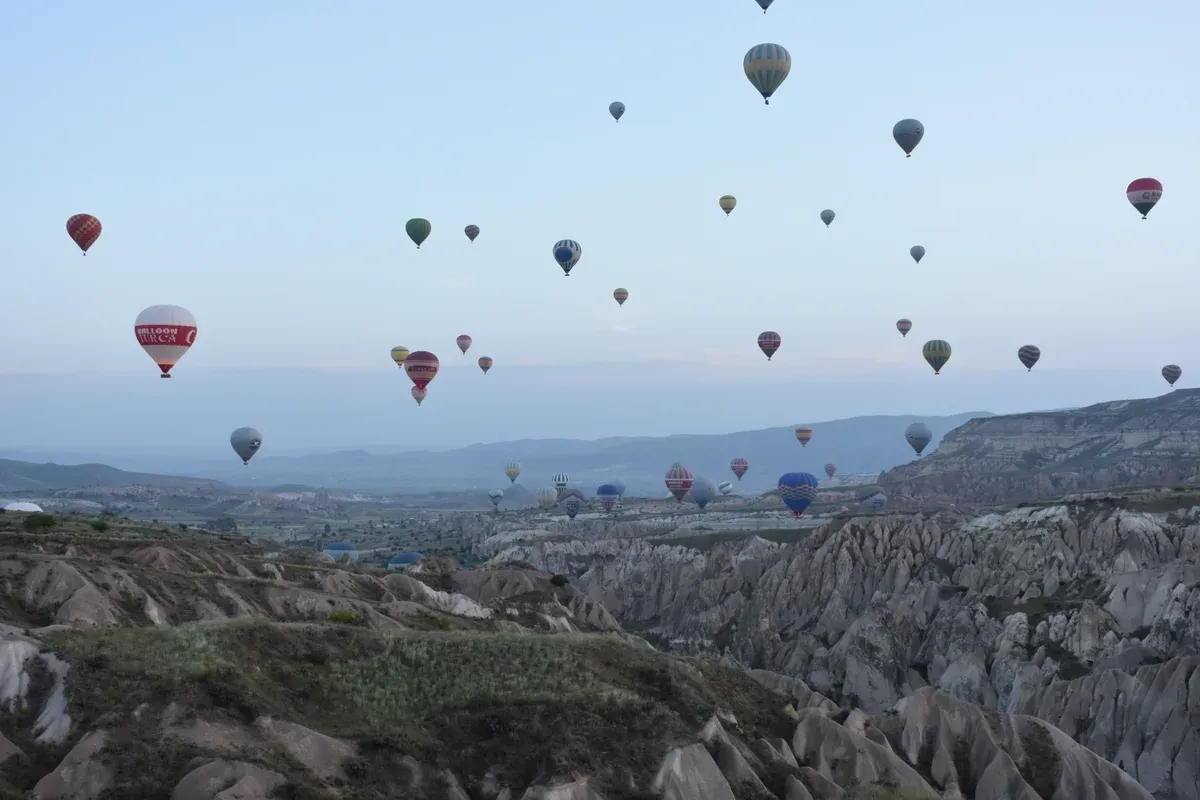
Balloons over the valleys near Goreme at dawn. Photo: MusikAnimal, CC BY-SA 4.0, via Wikimedia Commons
Timing a Tour Package
Each season changes what a package from Istanbul delivers and what it costs.
High Season: Book the Flights Early
June to August is the peak season, with seaside resorts at their busiest and price levels rated highest. Turkish school holidays from mid-June to mid-September add coastal crowds. This matters for package tours because they move on domestic flights.
Nevsehir Kapadokya Airport carried 754,489 passengers against a capacity of 2 million, and Kayseri Airport handled about 2,765,751 passengers. Those seats are finite and the biggest packages need three of them per person: the 7-Day Best of Turkey Tour includes 3 domestic flights, Istanbul to Cappadocia, Cappadocia to Ephesus and Pamukkale back to Istanbul, for $1,713 per person. In July the Aegean days get hard: Ephesus sees 10:00 to 14:00 crowded and about 38 C, and Denizli, the station for Pamukkale, reaches a mean daily high of 35.7 C in both July and August.
If summer is your only window, plan the ruins for 08:00 or after 16:00 and compare more options in the Turkey tour packages roundup.
Shoulder Season: The Sweet Spot for Packages
April to May and September to October are the shoulder season, when the crowds thin out. April, May, October and November are described as ideal for Ephesus, and Izmir's October mean high is 24.6 C against a July high of 33.8 C. Nevsehir, the Cappadocia station, averages a 19.1 C high in October with only 29.4 mm of rain. It is also the main balloon season: one guide calls April to November the peak balloon season, with flights year-round weather permitting.
Cappadocia vineyard colours are rated an October highlight, and one guide says October prices run 10 to 15 percent below September. If you only have time for Cappadocia, the shorter fly-ins pack the region into two days, for example the 2-Day All-Inclusive Cappadocia Trip at $674 with a cave hotel night and skip-the-line museum tickets, or the 2-3 Day Cappadocia Tour with Flights at $343 where entrance fees are excluded.
Winter: Cheaper, Quieter, Colder
November to March is the low season, with lower prices and many seaside shops and restaurants closed. Price levels are rated lowest in January, February and December. A winter Cappadocia is a real thing: the plateau sits over 1,000 m high, and Nevsehir averages a 4.1 C high and a -3.5 C low in January.
Snow brings more balloon cancellations, since balloons cannot fly in rain, fog or snow and one guide puts the wind limit at 11 knots. With a 2-day trip you get one cave hotel night and one dawn window, so a grounded balloon leaves no second try. The 3-Day Cappadocia Tour with Balloon sells the balloon as an option, so read its cancellation terms before booking in winter. For the full route in winter, check the sample Turkey itinerary and confirm which sights keep their hours.
Seasonal Tips
Do
- Do travel in April, May, September or October because the shoulder season combines thinner crowds with the ideal window listed for Ephesus and the peak balloon season in Cappadocia.
- Do book your balloon for the first morning of your stay and keep spare mornings, because a red flag cannot be reversed once published and a green flag still leaves the final call to the pilot.
- Do arrive at Ephesus at 08:00 or after 16:00 in summer, because 10:00 to 14:00 is crowded and about 38 C.
- Do plan around the Bayrams, because Ramazan Bayrami brings heavy domestic travel from the day before which matters for packages that rely on domestic flights.
- Do visit the tulip parks on a weekday morning before 9:00, because Emirgan Park is free daily from sunrise to sunset and April weather of 8 to 17 C is changeable.
Don't
- Don't rely on daytime restaurants in Istanbul in the first half of Ramadan, because the guide advises avoiding that window in cities.
- Don't plan beach time from November to March, because many beach hotels close and Mediterranean resorts may be shut in winter.
- Don't count on a balloon flight with only one morning in Cappadocia in winter, because snow on the plateau brings more cancellations.
- Don't book the coast for late July if you hate heat, because Denizli hits 35.7 C and Fethiye 35.4 C, and crowds run at their peak from June to August.
FAQ
Which month is Turkey the cheapest?
One month-by-month guide rates price levels as lowest in January, February and December, and Turkey Travel Planner calls November to March the low season with lower prices. See the timing notes in the Turkey tour packages guide.
What is the best month to go to Turkey?
One planner ranks spring first, autumn second, summer third and winter last, and suggests March and November for lower prices and smaller crowds. The shoulder months of April to May and September to October thin the crowds on the classic route described in the Turkey itinerary.
When is the best time to visit Cappadocia?
For balloons, guides call April to November the peak season, with flights year-round weather permitting and stronger winds from December to April. For snow landscapes, Cappadocia is rated snowy in December and January, with January nights averaging -3.5 C and sunset around 4:45 pm in late December.
When is the best time to visit Istanbul?
July is the city's driest month at 36.3 mm of rain with a 28.0 C mean high, while April brings the Tulip Festival through the month and October prices run 10 to 15 percent below September. Istanbul gets about 15 snow days a year, mostly December to February.
Is Ramadan a bad time to visit Turkey?
Not necessarily, but plan food and crowds. The FCDO advises against eating, drinking or smoking in public in the daytime during Ramadan, and one guide advises avoiding the first half of the month in cities if you rely on daytime restaurants. The exact start moves each year and is not certain until confirmed.
Is it safe to travel in the season I choose?
Season changes weather and crowds. Safety has its own guide: see is Turkey safe.